
Analyzing refractive changes after anterior segment surgery:
Evaluating refractive change after ocular surgical procedures requires the consideration of both the amount and the angle (i.e. direction) of the astigmatism. The astigmatic value is considered a polar vector; its range of direction is a half circle of 180 degrees. For convenient usage of trigonometric computations it should be converted to a double angle value with a full circle of 360 degrees, and the resultant angle reconverted to a polar notation by multiplying it at ½.
The mathematical representation and statistical manipulation of spherocylindrical refractive errors is a recurring topic in ophthalmic literature. In general, statistical analysis of angular data is fundamentally different from the analysis of nondirectional data. Consequently, the inappropriate application of conventional statistical methods to directional data can give very misleading results.
This calculator is especially designed for power vector analysis of the optical outcome of refractive surgery.
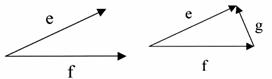
Vectors as shown in this figure could be added or subtracted considering their both amount and direction:
f + g = e
e – f = g

Operation of my calculator:
It is made to perform the trigonometric analysis of surgical vectors. Refraction data of an individual subject at a given vertex distance is entered in the white boxes at minus or plus cylinder format. The astigmatism is converted to an absolute (positive) value and at the corneal plane. Surgical vectors and indices are calculated according to the definitions made by Dr. Noel A. Alpins (SURVEY OF OPHTHALMOLOGY VOLUME 49, NUMBER 1, JANUARY–FEBRUARY 2004, and J CATARACT REFRACT SURG—VOL 27, JANUARY 2001):
Analysis of treatment (method of Dr. Alpins)
1. Target induced astigmatism vector (TIA): The astigmatic
change (by magnitude and axis) the surgery was intended to induce
2. Surgically induced astigmatism vector (SIA): The amount
and axis of astigmatic change the surgery actually induces.
3. Correction index (CI): Calculated by determining the
ratio of the SIA to the TIA (what the surgery actually induces versus what the
surgery was meant to induce), calculated by dividing SIA (actual effect) by TIA
(target effect). The CI is preferably 1.0 (it is greater than 1.0 if an
overcorrection occurs and less than 1.0 if there is an undercorrection).
4. Magnitude of error (ME): The arithmetic difference
between the magnitudes of the SIA and TIA. The magnitude of error is positive
for overcorrections and negative for undercorrections.
5. Angle of Error (AE): The angle described by the vectors
of the achieved correction versus the intended correction.
The AE is positive if the achieved correction is on an axis
counter-clockwise (CCW) to its intended axis and negative if the achieved
correction is clockwise (CW) to its intended axis.9
6. Difference vector (DV): The change (by magnitude and
axis) that would enable the initial surgery to achieve the original target on
the second attempt. The DV is an absolute measure of success and is preferably
0.
7. Index of Success (IOS): Calculated by dividing the DV by
the TIA (the intended treatment). The IOS is a relative measure of success and
is preferably 0.
8. Flattening effect (FE): The amount of astigmatism
reduction achieved by the effective proportion of the SIA at the intended
meridian.
9. Flattening Index (FI): Calculated by dividing the FE by the
TIA and is preferably 1.
10. Torque: The amount of astigmatic change induced by the
SIA that has been ineffective in reducing astigmatism at the intended meridian
but has caused rotation and a small increase in the existing astigmatism.
Torque lies 45 degrees CCW to the SIA if positive and 45 degrees CW to the SIA
if negative.
11. Spherical correction index (S.CI):
Spherical equivalent correction
achieved/Spherical equivalent correction targeted
12. Spherical Difference (SDiff):
[Spherical equivalent achieved - spherical
equivalent targeted] (absolute)
13. Index of success of spherical change (S.IOS):
Spherical difference/Spherical
equivalent correction targeted
14. To express indices as percentages:
Percentage of astigmatism corrected: CI
× 100
Percentage of astigmatism reduction at
the intended axis: FI × 100
Percentage success of astigmatism
surgery: (1.0 - IOS) × 100
Percentage of sphere corrected: SCI ×
100
Percentage success of spherical surgery: (1.0 - Sph IOS) × 100